
While this article focuses on CQC registration and service expansion in England, the same underlying principles apply across the UK. Providers operating in Wales and Scotland will recognise similar expectations within Care Inspectorate Wales (CIW) and the Care Inspectorate in Scotland. Although the systems, terminology, and processes differ, regulators consistently assess clarity of service model, governance arrangements, leadership capability, and readiness to deliver safe, effective care.
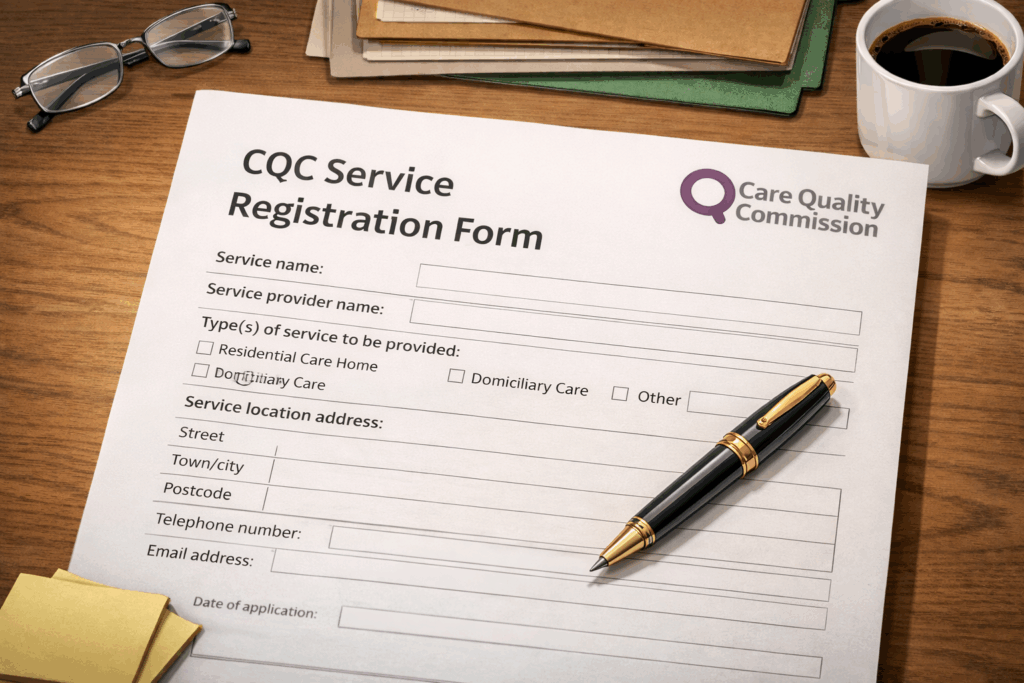
Registering a new service or expanding an existing one is a significant step for any care provider. While the Care Quality Commission (CQC) sets out clear guidance on registration requirements, many applications are delayed or questioned because providers underestimate the level of preparation expected.
Experience supporting providers through registration and variation processes shows that outcomes are rarely determined by intent alone. They are shaped by how clearly the service model, governance arrangements, and leadership capability are evidenced at application stage.
This article outlines the key areas providers need to get right when planning CQC registration or service expansion.
1. Be clear about the service model from the outset
One of the most common weaknesses in registration and variation applications is a lack of clarity about the service being proposed.
Providers should be able to clearly articulate:
- Who is delivering the service, including the provider type (individual, organisation, or partnership)
- What the service will deliver, including the nature and scope of care or support
- Who the service is for, including client groups and needs
- Where the service will operate, including geographical scope and settings
- How care and support will be delivered in practice, not just in policy
- How governance and oversight will be structured, including accountability and quality assurance
- How the service will be safe, effective, responsive, caring, and well-led, in line with regulatory expectations
Ambiguity at this stage frequently leads to follow-up questions, requests for clarification, or delays in progressing applications.
Good practice is to define the service model early and ensure it is consistently reflected across the application, Statement of Purpose, policies, and business planning documents.
2. Regulated activity and scope, and submitting the application for registration
Applications frequently run into difficulty where the regulated activity, service type, or scope is not properly aligned with the proposed model.
Providers should confirm:
- Which regulated activity or activities apply
- Whether personal care is being delivered
- How the scope aligns with geography, service user groups, and settings
Providers should also ensure that they are clear on the required documentation for their service type, as CQC requests different policies and supporting documentation dependent on the type of service and regulated activity being registered.
At present, CQC registration applications are submitted electronically, typically via structured application forms and supporting documents provided by email rather than through a live online portal. Providers are required to complete the relevant application forms, supply supporting evidence, and clearly set out how the proposed service meets regulatory requirements. CQC’s assessment is therefore heavily reliant on the quality, clarity, and consistency of the written information submitted.
Misalignment here can result in delays, the need to resubmit elements of the application, or rejection.
3. Type of provider and Governance
CQC registration applications are structured around three provider types: individual providers, organisations, and partnerships. While the application routes differ slightly depending on the provider type, the underlying regulatory expectations remain consistent. In all cases, regulators assess clarity of accountability, governance and oversight arrangements, leadership capability, and the provider’s readiness to deliver safe and effective care. Providers must therefore ensure that their chosen application route is supported by appropriate governance structures and clearly defined responsibilities.
CQC expects governance arrangements to be appropriate to the size, complexity, and risk profile of the service.
This includes:
- Clear management oversight
- Defined roles and responsibilities
- Quality assurance and audit processes
- Risk management and escalation arrangements
Governance that is either overly generic or unrealistically complex can undermine confidence in the application.
Good governance demonstrates control, not paperwork volume.
4. Policies must reflect how the service will actually operate
Policies are not assessed in isolation. CQC considers whether they align with the service model and are capable of being implemented in practice.
Common issues include:
- Policies copied from unrelated services
- Lack of alignment with the proposed client group
- Procedures that do not match staffing or operational plans
Policies should be tailored, current, and clearly linked to how the service will function day to day.
5. Statement of Purpose
The Statement of Purpose is a foundational regulatory document and is closely scrutinised as part of the registration process. It must accurately describe the service being registered and be fully consistent with the application, governance arrangements, and supporting policies. Discrepancies between the Statement of Purpose and other submitted information are a common cause of delay, as they raise concerns about clarity of service intent and operational readiness. Providers should ensure the Statement of Purpose is clear, current, and inspection-ready from the outset.
6. Leadership capability is critical
CQC places significant weight on the suitability and preparedness of the Registered Manager (RM) and Nominated Individual (NI), including their qualifications, experience, and compliance with Fit and Proper Persons requirements.
Providers should ensure that:
- Roles, accountability, and decision-making authority are clearly defined
- The RM has an enhanced DBS check in place, countersigned by CQC and no older than 12 months at the point of application
- The RM holds, or is actively working towards, an appropriate management qualification relevant to the regulated activity and service type e.g. Level 5 Diploma in Leadership for Health and Social Care
- Both the RM and NI meet Fit and Proper Persons requirements, including suitability, integrity, and competence
- Leaders have a clear understanding of the service model and regulatory expectations
- Governance arrangements support effective oversight, challenge, and quality assurance
Preparation for CQC interviews is an essential part of the registration process and should not be treated as a formality. These discussions are used to test leadership capability, understanding of regulatory requirements, and readiness to manage the regulated activity.
Preparation is often most effective where the Registered Manager (RM) and Nominated Individual (NI) take part in a structured mock interview. Using questions commonly asked by CQC allows leaders to practise articulating their understanding of the service model, governance arrangements, and decision-making responsibilities in a clear and confident way.
7. Financial viability and sustainability
CQC also considers whether a provider is financially viable and able to sustain the proposed service safely over time. Applications should demonstrate that the service model, staffing assumptions, and governance arrangements are supported by realistic financial planning. This includes clarity on income streams, anticipated costs, and the provider’s ability to manage financial risk. Where financial assumptions are unclear or misaligned with the proposed service delivery, CQC may seek further assurance or delay progression of the application.
8. Expect questions and requests for further information
CQC registration is rarely a single-step process. Requests for clarification or additional documentation are common, particularly where applications involve new service models or expansion into new areas.
Providers should plan for:
- Follow-up questions
- Requests for additional evidence and/or policies and other relevant documentation
- Further explanation of governance or delivery arrangements
Responding clearly and consistently helps maintain momentum and confidence in the application.
9. Post-registration readiness
CQC’s assessment does not end at the point of registration approval. Providers are expected to be operationally ready to deliver safe and effective care immediately following registration. This includes having staffing arrangements in place, governance systems actively operating, and quality assurance processes already underway. Applications that rely on future intentions rather than demonstrable readiness can undermine confidence and prompt further scrutiny. Registration should therefore be approached as preparation for live service delivery, not simply a procedural milestone.
10. Expansion requires the same discipline as initial registration
Variations to registration and service expansion are often approached as administrative changes. In practice, CQC assesses them with the same level of scrutiny as new registrations, focusing on whether the provider can safely manage increased scale or complexity without compromising quality.
Providers should be able to demonstrate that expansion is supported by:
- Sufficient management capacity to maintain effective oversight as services grow
- Robust quality assurance and risk management arrangements that operate across the expanded service
- Clear evidence of financial sustainability, including the ability to absorb growth-related costs
- Realistic staffing and recruitment plans that align with the proposed expansion
Expansion should therefore be evidenced as a controlled and planned development, strengthening service delivery rather than diluting leadership, governance, or quality.
Final thoughts
Successful CQC registration and service expansion are built on preparation, clarity, and realistic governance.
Providers that take time to define their service model, align documentation, and prepare leadership teams place themselves in a much stronger position to progress smoothly through the registration process.
Can we help?
If you are planning a new registration, variation, or service expansion and would value structured, proportionate support, we’re happy to discuss how we can help.